WAiFF 2026 — Debriefing the second edition
[BY]
Axelle Baudlot
[Category]
Stories
[DATE]
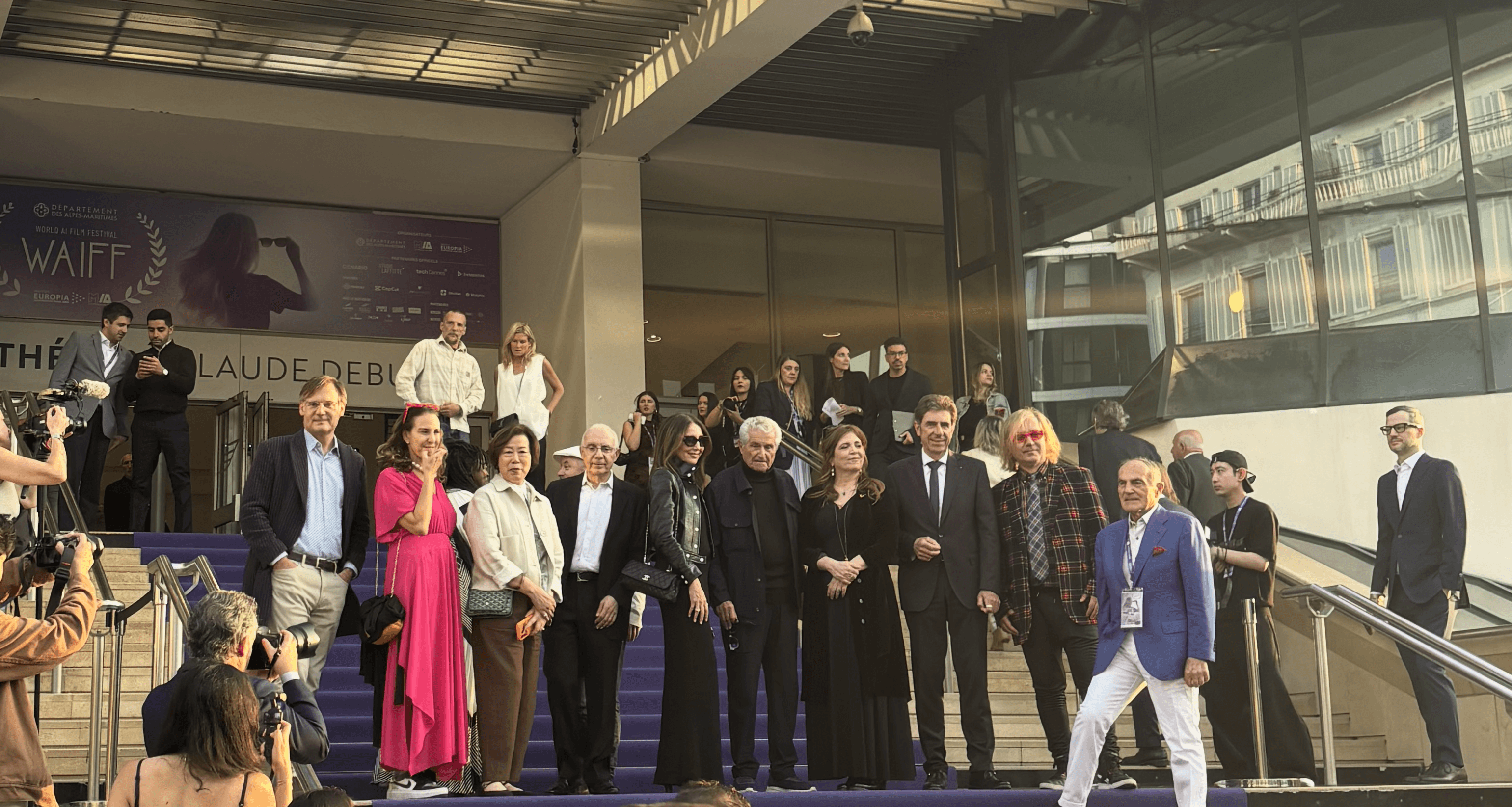
Two days. The Palais des Festivals. And the confirmation that something has truly taken hold. The second edition of the World AI Film Festival took place on April 21 and 22, 2026, in Cannes. Genario was a co-organizer. Here are the key takeaways.
A visible rise in momentum right from the badges
The first striking thing, on the morning of April 21st, was the international density of the accredited participants. Brazil, South Korea, Japan, China, Italy, United Kingdom. A significant press presence. In one year, the WAiFF has scaled up — and you could see it in the room even before the first panel began.
Day 1 — AI as a continuation, not a disruption
Jean-Michel Jarre opened the festival with a phrase that set the stage for the entire day: today we are living through the same moments as the Lumière Brothers at La Ciotat station. Coming from him, here, it carried weight.
The first panel, moderated by Serge Hayat, extended this idea with concrete examples. Director Nathalie Marchak explained how she gave up filming tiger sharks in the Bahamas to recreate the scene with AI — not for budget reasons, but because of human risk and environmental impact. A producer from MiniMax pointed out that a five-second scene now costs twenty cents to generate. And this line from producer Enora Contant caught everyone's attention: we talk a lot about form, but what keeps a viewer on the edge of their seat is the narrative.
The second panel addressed a central question: who captures the value in this economic reorganization? The answer was surprising. Cécile Lacoue, from the CNC, pointed out that film budgets are not decreasing — they remain around five million euros on average. What is saved thanks to AI is reinvested elsewhere: more ambition, more preparation, more value on screen. Caroline Cooper, at Sky, confirmed this from the broadcaster's end: we aren't looking to pay less. We are looking to remain competitive with a standard of excellence that is rising.
Laurent Jaoui, from TéléFan, opened up a front that few dare to face directly: when images are generated using models trained solely in the United States and China, we do not produce a neutral image — we replay a cultural hegemony. The question of the sovereignty of European creative imaginations has become one of the most strategic topics of this edition.
The day ended with Claude Lelouch and Mathieu Kassovitz on stage. At 88 years old, with 51 films under his belt, Lelouch is currently shooting his 52nd — in a hybrid way, with AI, ten minutes at a time. He talks about it like a toy he never expected to find at his age. Anyone who still thinks this technology is just for young people should have attended this conversation.
Day 2 — The rules of the game in debate
The tone of the second day shifted. Less poetry about cinema, more confrontation over the rules of the game.
Johann Choron and Sarah Cledy, from Google, summarized the current moment with a phrase that went around: we are building the plane while flying it.
The panel on copyright, moderated by Sarah Lelouch, was the most electric of this edition. Agnès Jaoui, president of the jury, set the stage with clarity: this opposition between those who are for or against AI is a bit absurd. Mathieu Kassovitz was more radical: AI doesn't choose for you, you choose for AI. Jérôme Enrico, from the ARP, proposed a structural path forward: let's share the profits, since we are the fuel. Dr. Tim Kraft, for his part, pointed out that OpenAI has already been condemned in Germany, with around 140 proceedings underway worldwide.
The closing panel, Back to the Future, moderated by Rémi Tereszkiewicz, concluded with a powerful image shared by Joanna Popper from Los Angeles: AI is shattering the industry. The giants capture the value, while the mid-level jobs that kept productions running are gradually disappearing. The problem is not technological, it is social. Gregg Bywalski, from Webedia Creators, extended this observation: YouTube and TikTok creators are no longer kids in their bedrooms — they are the producers of tomorrow's IPs.
The ceremony — and what it says about the festival
On the evening of April 22nd, the winners received their awards like receiving a Palme d'Or. The winning films were of a level that nobody expected for a second edition. True stories being told. Images with a confident style. Cinema — not generated content.
Seeing the joy of creators from all over the world receiving this recognition says everything about what the WAiFF is building: already a benchmark, after just two editions.
What Genario takes away from this
Co-organizing the WAiFF means participating in building a framework where cinema can continue to think and invent itself. This edition confirmed that the challenge is not technical. It is narrative, economic, legal, cultural — and deeply human.
See you at the third edition.